
 EN
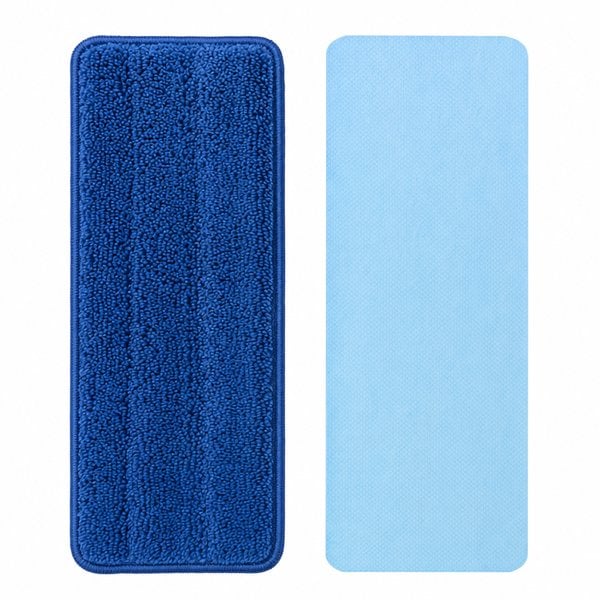
Choose reusable microfiber mop pads when the building has a laundry route, a stable floor plan, and staff who return pads to a controlled loop. Choose disposable mop pads when the soil and the cloth should leave the room together, as in isolation cleaning, restroom turnarounds, and spill response, or when there is no laundry capacity at all. Many programs end up running both.
That split is a procurement decision, not a cleaning preference. It changes what you specify, how a contract price is built, and what a goods-in inspection can verify.
Five points shape the comparison. The formats are specified in different terms: a reusable pad by construction and wash durability, a disposable pad by basis weight, wet strength, and attachment. Reusable mop pads move cost into laundry labor and storage; disposable pads move it into usage rate and waste. Contamination control comes from the procedure and the color code, not the format. Attachment is the most common compatibility failure, and it is settled before price. Test both formats on the same floor before committing a contract.
Quick comparison: how the two formats differ at the specification stage
Eight factors separate microfiber mop pads from disposable mop pads before price.
Fabric: knitted microfiber mop pads with a pile surface, often split polyester and polyamide, against nonwoven or lightweight knit supplied dry or pre-wetted.
Attachment: a pocket, clips, or a hook-and-loop backing onto a reusable frame, against clips, an adhesive strip, or a light frame pocket.
Service life: repeated wash and reuse with inspection between cycles, against disposable mop pads used for one task, one room, or one shift.
Contamination control: washed and reused under a color code, against soil that leaves the building with the pad.
Laundry dependency: on-site or contracted laundry, chemistry control, and drying capacity, against stock and a waste route for disposable mop pads.
Cost driver: cost per use set by cycle count and laundry cost, against cost per pad set by usage rate.
Storage: a small working stock with a buffer between cycles, against par levels per floor.
Typical fit: routine daily floors with a controlled laundry loop for reusable mop pads, against isolation cleaning, restrooms, spills, and sites without laundry.
Material and construction differences that change the specification
Reusable mop pads are built to survive washing. The specification for microfiber mop pads has to describe the knitted structure, the pile, the backing, and the edge, and state what the pad must measure after a defined number of cycles. Weight is quoted as GSM with a tolerance, because a pad at the low end of an unstated band is compliant but thinner in use.
The backing fails first. A laminated backing that separates from the knit turns the pad into scrap, usually after several washes rather than at goods-in. Edge construction, whether overlock, ultrasonic cut, or bound, controls fraying and the loose fiber that reaches the floor. Both belong in the purchase order.
Disposable mop pads are built to perform once. The relevant fields are basis weight, wet strength, attachment, and, for pre-wetted products, chemical compatibility with the floor finish and the frame. Asking a disposable supplier for wash-cycle performance wastes a sample round, as does asking a reusable supplier for wet strength in a sealed pack.
Attachment deserves its own line in the quotation. Reusable mop pads shrink on the first wash, so the order should carry cut size and finished size with a tolerance in millimeters.
Application fit: hotels, healthcare, contract cleaning, and industrial sites
In hotels, the decision usually splits by task. Guest bathroom floors are cleaned daily and at volume, which suits reusable mop pads under a color code. Checkout deep cleans, spill response, and rooms taken out of service are easier to control with a disposable pad, because nothing contaminated returns to the laundry.
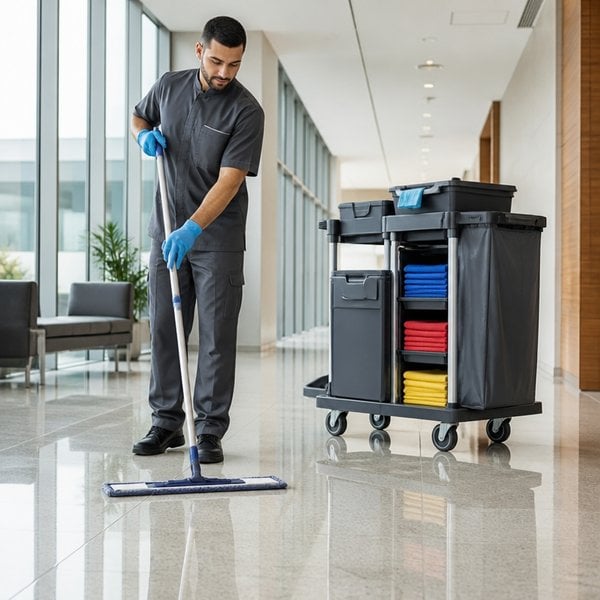
In healthcare, the buyer's infection-control policy decides, not the supplier. Routine patient-room floors and isolation cleaning are different procedures, and a disposable pad removes the transport of a contaminated cloth through the building. Reusable mop pads work only where soil separation, wash control, clean storage, and staff compliance are all in place.
Contract cleaners face the clearest constraint: laundry access. A contractor running several sites from one depot can launder pads centrally, but adds transport, loss, and buffer stock that has to be counted. A contractor without laundry buys disposable mop pads or pays a third party.
Industrial and workshop floors reverse the logic. Metal fines, oil, abrasive dust, and coarse concrete shorten the life of any pad and make contaminated laundry expensive. Disposable mop pads keep that soil out of the wash process; reusable mop pads need pre-treatment, separate soil classification, and a realistic replacement rate.
Cost per use and maintenance: what the purchase price leaves out
Comparing reusable mop pads with disposable mop pads on price answers nothing: the two cover different work. Build a cost per use worksheet from your own trial rather than a quotation. Six lines belong in it.
Purchase: pad price divided by the uses confirmed in your trial, against pack price divided by pads per pack, both expressed as a cost per use.
Laundry: energy, water, chemistry, labor, and machine time per cycle, with no disposable equivalent.
Handling: collect, sort, load, fold, and reattach, against restock, open, attach, and discard.
Losses: pads discarded early or rejected at inspection, against over-use, damaged packs, and expired stock.
Storage: reusable mop pads need working stock plus a wash-cycle buffer, against par levels on site.
Waste: end-of-life textile disposal, against volume and disposal cost per shift.
Two lines in a cost per use model are routinely missed. The first is laundry labor: a reusable program relocates work rather than removing it, and the relocation only pays at volume. The second is loss, because pads leave in bin bags, get used for spills, or fail inspection early.
Maintenance decides whether reusable mop pads keep performing. Fabric softener coats the fiber and reduces pickup; over-drying makes the pile brittle; mixing restroom pads with food-area pads defeats the color code; and damp storage produces odor that no later wash removes. None are product faults, and all arrive as complaints.
Disposable mop pads have a shorter maintenance list, but a real one. Pre-wetted stock has a shelf life and a storage condition. Par levels must be set per area, because the format removes the buffer a laundry loop provides, and the waste route must exist before the first pallet arrives.
Buyers who run microfiber mop pads alongside disposables often consolidate with one supplier to keep the specification language consistent. Cozihome quotes the two formats separately for that reason: a blended price hides which route carries the cost.
A procurement checklist and a trial that answers the question
Before requesting samples, settle the operational inputs. Each changes the specification, and no supplier can quote around a gap.
- Floor types and finishes, including any surface that marks easily.
- Soil type: dust and grit, grease, body fluid, metal fines, or chemical residue.
- Mop frame model, pad dimensions, and attachment already in use.
- Laundry route for reusable mop pads, daily capacity, and who controls the chemistry.
- Waste route and storage space, if disposable mop pads are under consideration.
- Contamination policy, including areas needing a fresh pad per task.
- Color code, if one exists, and the zones it maps to.
- Pads consumed per shift, from current records rather than estimates.
- Acceptance criteria: weight tolerance, finished size after washing, edge integrity.
- Packaging and labeling requirements for the destination market.
Then run a controlled trial on microfiber mop pads and disposables: one floor, one operator, one chemical, and where possible the same frame. Record pads used per shift, laundry rejects, and rework, and photograph the floor under the same light each week.
Where each format stops working
Reusable mop pads fail where the laundry is undisciplined: softener, overloaded machines, mixed soil levels, and partial drying return a pad that looks clean and performs badly. They also fail on very rough floors, and where pads are discarded early, so the cost model drifts toward the disposable case without its convenience.
Disposable mop pads fail on large open areas where the change rate per square meter outruns the labor saved, on rough surfaces that tear a nonwoven sheet, and where a pre-wetted chemistry is incompatible with the finish. They also fail as contamination control if the pad is reused for one more room.
Neither reusable mop pads nor disposable mop pads substitute for a procedure. A color code that is not enforced is decoration, and the comparison only resolves once the procedure, the laundry or waste route, and the supervision model are fixed.
Request a side-by-side sample pair
Send your floor types, mop frame and pad dimensions, daily area, laundry or waste route, and target order quantity. Cozihome supplies both reusable mop pads and disposable mop pads to B2B cleaning programs and will reply with a sample pair, the fields still open, and what can be confirmed before a quotation.