
 EN
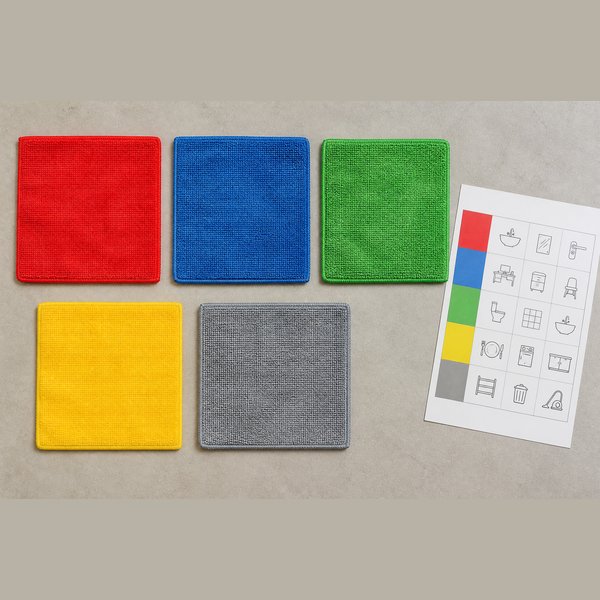
Color-coded microfiber programs rarely fail because the cloth cannot clean. They fail at the handover between a cleaning procedure and a purchase order: the shade drifts between dye lots, the hem arrives narrower than the approved sample, the fabric weight is close but not the same, or the bag label carries the wrong language.
This guide covers the procurement sequence for OEM color-coded cloths in food processing, healthcare, contract cleaning, and facility maintenance: defining the requirement, building the specification sheet, approving samples, settling packaging, and holding batch consistency.
Five decisions shape the order. The color code is an operating control, so write the zone and task mapping before the cloth specification. The sheet should lock eight fields: blend, fabric weight, size, construction, edge, color standard, packing, and acceptance criteria. Approve three samples rather than one: a color and hand swatch, a finished pilot sample, and a pre-production sample made with production materials. Ask for minimum order quantity and lead time per color, not once for the whole program, and put defect definitions and approved artwork inside the purchase order rather than in an email thread.
Define the cleaning program before the cloth
In a color-coded system, each color carries an instruction: this cloth stays in this zone, this cloth never touches that surface. That instruction is the real product requirement. If the buyer cannot state the mapping in one table, no supplier can quote it accurately and no inspection can confirm whether the delivered cloth supports the procedure.
Five inputs belong in the program brief. The zone and task map sets the number of colors and whether each color needs its own fabric lot. The cleaning chemicals in use set the dye fastness and rinse requirements that the sample must survive. The laundry route sets the shrinkage allowance, the edge durability, and the wash cycles used in color testing. The surfaces being cleaned set the construction, the pile, and the lint limit the buyer accepts. The replacement cycle sets the weight band, the size, and the pieces per pack.
Two of these inputs drive the quotation. The number of colors divides volume: a supplier may accept the total quantity and still decline one color at its per-color quantity. The laundry route determines the dye system, because a cloth washed hot with alkaline detergent is not the same product as one rinsed and reused dry.
Build a specification sheet a factory can quote against
Vague adjectives create predictable disputes. “Premium” and “heavy duty” cannot be measured at goods-in, so they cannot settle an argument about a delivery. Use eight fields instead, each with a number, a tolerance, and a test method.
Fiber blend is the polyester and polyamide ratio, written as a range with the method used to verify it, because it governs absorbency, hand, lint, and cost per piece. Fabric weight is GSM with a tolerance band, stated as greige or finished and conditioned or as received, because it drives durability and price per square meter. Size covers cut size, finished size after the first wash, shrinkage allowance, and tolerance in millimeters; together these set fit, fold count, and pack dimensions. Construction is knit or woven, pile height, and density, and it controls surface contact, lint release, and scratch risk.
Four fields remain. Edge is overlock, ultrasonic, or bound, with width, stitch density, and thread specified, since this decides fraying and usable surface. Color needs a physical standard or signed lab dip, the evaluation light source, and the number of wash cycles before the shade is re-checked. Packing covers pieces per bag, insert or header card, carton count, dimensions, and label placement, which set landed cost and warehouse handling. Acceptance covers defect definitions, the sampling plan, the inspection point, and who inspects, and it decides whether a delivery is accepted or rejected.
A weight tolerance is not a formality. If the sheet says 300 GSM without a band, a delivery at 285 GSM is arguably compliant and the buyer has no documented basis to reject it. State the band, the measurement method, and how many pieces are measured per lot. Size needs the same discipline: cut size and finished size are different numbers once the fabric shrinks, so the order should carry both.
Color is the field most often left to a photograph, and a screen image cannot be an acceptance standard. Approve a physical reference, record the light source used to compare it, and agree how many washes the cloth must survive before the shade is re-checked.
Approve samples in three stages
A single “sample” collapses several decisions into one approval, which is where OEM disputes begin. Separate them: the swatch proves color and hand, the pilot sample proves construction, and the pre-production sample proves that the production line, not the sample room, can repeat the result.
The first stage is a color and hand swatch, which proves dye shade and hand against the standard; record the reference number and the light source, and keep a retained duplicate. The second is a finished pilot sample, which proves cut size, edge, label, and bag as they will be sold; record measured dimensions, piece weight, GSM, and photographs. The third is a pre-production sample made from production fabric, production edge, and production packing, signed against a sealed sample, approved artwork, and a packing list.
Measure rather than judge by feel: fabric weight on a cut sample, finished dimensions after washing one piece, edge width at three points, and the packed weight of a full bag. Photograph each stage at the same distance and background so a later delivery can be compared without relighting the shot.
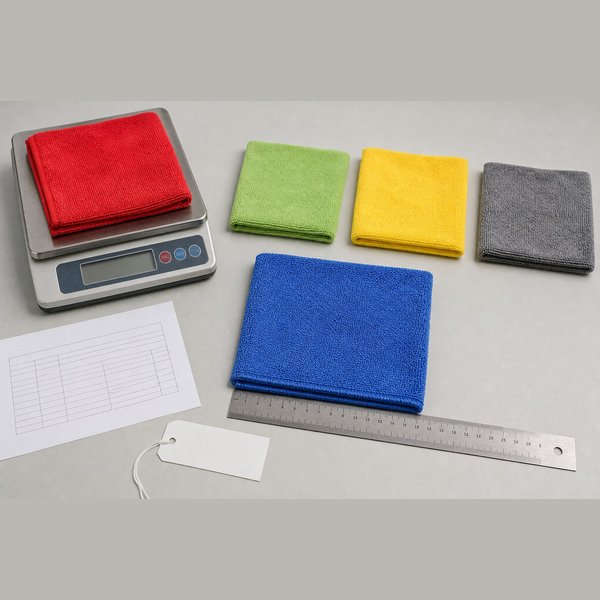
Approve the pre-production sample before bulk fabric is cut, not after. Once signed, it becomes the reference for the order and for reorders. A change afterwards, whether thread, label material, or carton count, should reopen the approval rather than be absorbed into production.
Settle packaging and labeling with the cloth
Packaging delays more OEM orders than fabric does, because it is treated as a purchasing detail rather than a production input. Printed cards, bag sizes, and label languages carry their own lead times and approval loops. Start them after the cloth is woven and the shipment waits on print.
Define the pack format in the same document as the cloth. For bulk programs, that means pieces per bag, bag thickness, insert card, master carton count, carton dimensions and weight, and markings. For retail-facing programs, add header card size and material, print method, barcode placement, and destination-market language. The importer of record confirms mandatory label content; a supplier cannot own a market requirement it was never given.
Approve artwork as a dimensioned PDF proof, not a photograph of a printed card. Check that the barcode scans at the specified size, that the adhesive suits the bag film, and that the printed color matches the cloth it identifies. Printed packaging carries its own setup quantity, separate from the cloth order, so ask for both numbers.
Control batch consistency with measurements
Two cloths can look identical on a table and differ by several grams per square meter, enough to change performance after repeated washing. The buyer’s protection is a sealed approved standard held by both parties, a small set of measurements taken per lot, and a record tying each carton back to its fabric lot and dye lot.
Ask for the batch record with the shipment: fabric lot, dye lot, cutting date, production line, packing date, and inspector. Keep the sealed standard in the same condition as the delivered goods, and compare new deliveries against it rather than against memory.
Five symptoms account for most batch disputes, and each has a control. A shade that differs between shipments usually means a different dye lot, or a different dye house for the top-up run, so keep the dye-lot record and check shade against the sealed standard before shipment. A cloth that feels thinner usually sits at the low end of an unstated tolerance or has a changed yarn, so measure cut samples per lot and state the band in the order. An edge that frays early points to lower stitch density or a substitute thread, so specify both and wash-test the sample before approval.
Labels that lift in the bag usually mean an adhesive incompatible with the film or with humid storage, so approve the label material and test adhesion on a packed bag. A short carton usually means manual packing variance at the end of a shift, so count packs before sealing.
RFQ checklist, common risks, and where this approach stops
An RFQ should be specific enough that two suppliers answer the same question. Send the specification sheet and close the gaps that quotations usually leave open.
- Which colors are required, and the minimum order quantity per color, quoted separately
- Fabric weight, tolerance, and the state in which it is measured
- Polyester and polyamide ratio, and how it is verified
- Cut size, finished size after the first wash, and shrinkage allowance
- Edge type, width, stitch density, and thread
- Lab dip lead time, and the wash cycles used for the color check
- Bag, card, and carton specification, including gross weight
- Artwork format, proof lead time, and any separate print setup quantity
- Pre-production sample contents and lead time
- Defect definitions, sampling plan, and inspection access for the buyer or a third party
- Lot and dye-lot traceability, retained sealed sample, and reorder dye-lot policy
- Price basis, packaging inclusions, and lead time per color versus the full order
Four risks recur. A quote materially below the others often reflects weight at the bottom of the tolerance band, a lighter bag, or a carton count that assumes compression. A sample pulled from stock proves the supplier can make the cloth, not that it can repeat the packing. A single minimum order quantity can hide per-color minimums. And a certification printed in a brochure is not a test report for the delivered lot.
The approach also has boundaries. It does not fit small quantities of ready stock, because sampling and print setup only pay back across a planned program. It is unnecessary where cloths are used dry and discarded quickly, and a color code only enforces a procedure when staff are taught the mapping and it is posted at the point of use.
Request a feasibility review
Send your specification sheet, packaging requirement, and target quantity per color. Cozihome produces color-coded microfiber cloths for B2B cleaning programs and will reply with what can be confirmed against current fabric and packing options, what needs a sample, and which fields still need a decision before a quotation can be issued.